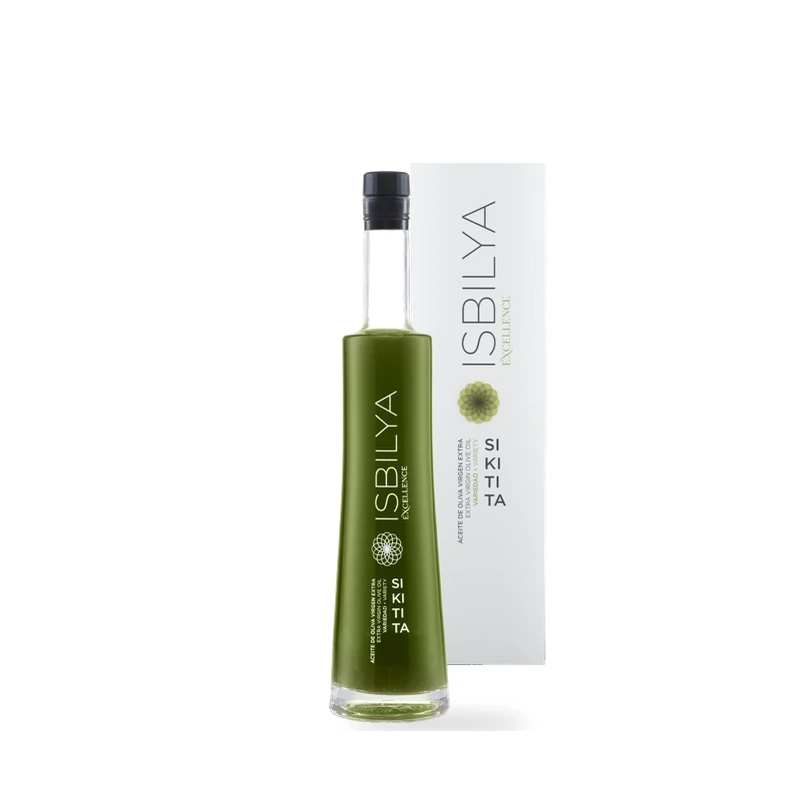
Isbilya Excellence Sikitita is the elegance of a young variety: Sikitita, born from crossing Picual and Arbequina, taking the structure of the first and the finesse of the second.
This edition is bottled unfiltered, just as it leaves the mill. Isbilya Excellence Sikitita is an oil with a subtle profile, made for fine raw cooking and for anyone who enjoys discovering nuances.
Isbilya Excellence Sikitita at a glance
 Variety
- Sikitita
 Origin
- Umbrete, Aljarafe (Seville)
 Harvest
- Early, mid-October
 Filtering
- Unfiltered
 Format
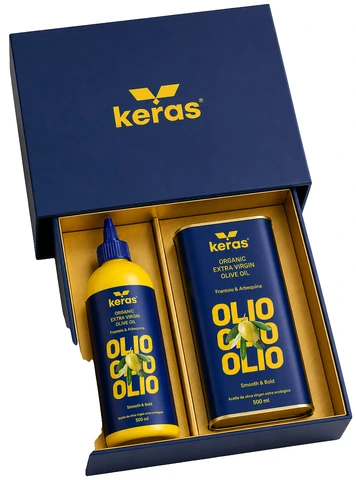
- 500 ml bottle in gift box
 Process
- Cold extraction
How Isbilya Excellence Sikitita tastes
Nose
A subtle, refined profile, with the freshness of olives picked green.
Palate
The structure of Picual and the finesse of Arbequina in a single oil.
Finish
An elegant finish, with nuances revealed in every spoonful.
From the Aljarafe, in under two hours
Isbilya is made in Umbrete, in the Aljarafe near Seville, by Aceites Yllanes Marini. Its olive trees grow as a continuous hedge, a layout that lets light reach the whole tree so the olives ripen evenly.
The harvest is brought forward to mid-October, while the fruit is still green, and done in the coolest hours, using only olives picked from the tree. In under two hours the olives reach the mill, where the oil is cold-extracted and bottled under an inert atmosphere.
Where Isbilya Excellence Sikitita shines
- Carpaccio and tartare.
- White fish and seafood.
- Salads with fruit and young leaves.
- Steamed vegetables, raw.
- Good bread, for tasting.
Isbilya Excellence Sikitita in a 500 ml bottle
The bottle comes in its gift box, which protects the oil from light. Being unfiltered, it may look slightly cloudy and show some natural sediment: the sign of an oil in its most direct state.
It is best used within the months after bottling and kept in its box, away from heat. Tasted side by side with the Koroneiki from the same estate, it shows just how different two varieties can be.
Frequently asked questions
What is Sikitita?
A modern variety born from crossing Picual and Arbequina.
Why might it look cloudy?
Because it is bottled unfiltered; the sediment is natural.
Which dishes is it best for?
Raw cooking: carpaccio, fish, salads and vegetables.
When should it be used?
Within the months after bottling.
Where is it made?
In Umbrete, in the Aljarafe near Seville, where Aceites Yllanes Marini grows its hedge olive groves and takes the fruit to the mill in under two hours.
Product information
- Food business operator: Aceites Yllanes Marini S.L., C/ Manuel Osuna, 2, 41806 Umbrete, Sevilla
- Origin: Umbrete, Seville, Spain
- Variety: Sikitita
- Contents: 500 ml
- Ingredient: Extra virgin olive oil
| Energy | 3700 kJ / 900 kcal |
|---|---|
| Fat | 100 g |
| of which saturates | 13 g |
| Carbohydrate | 0 g |
| of which sugars | 0 g |
| Protein | 0 g |
| Salt | 0 g |